
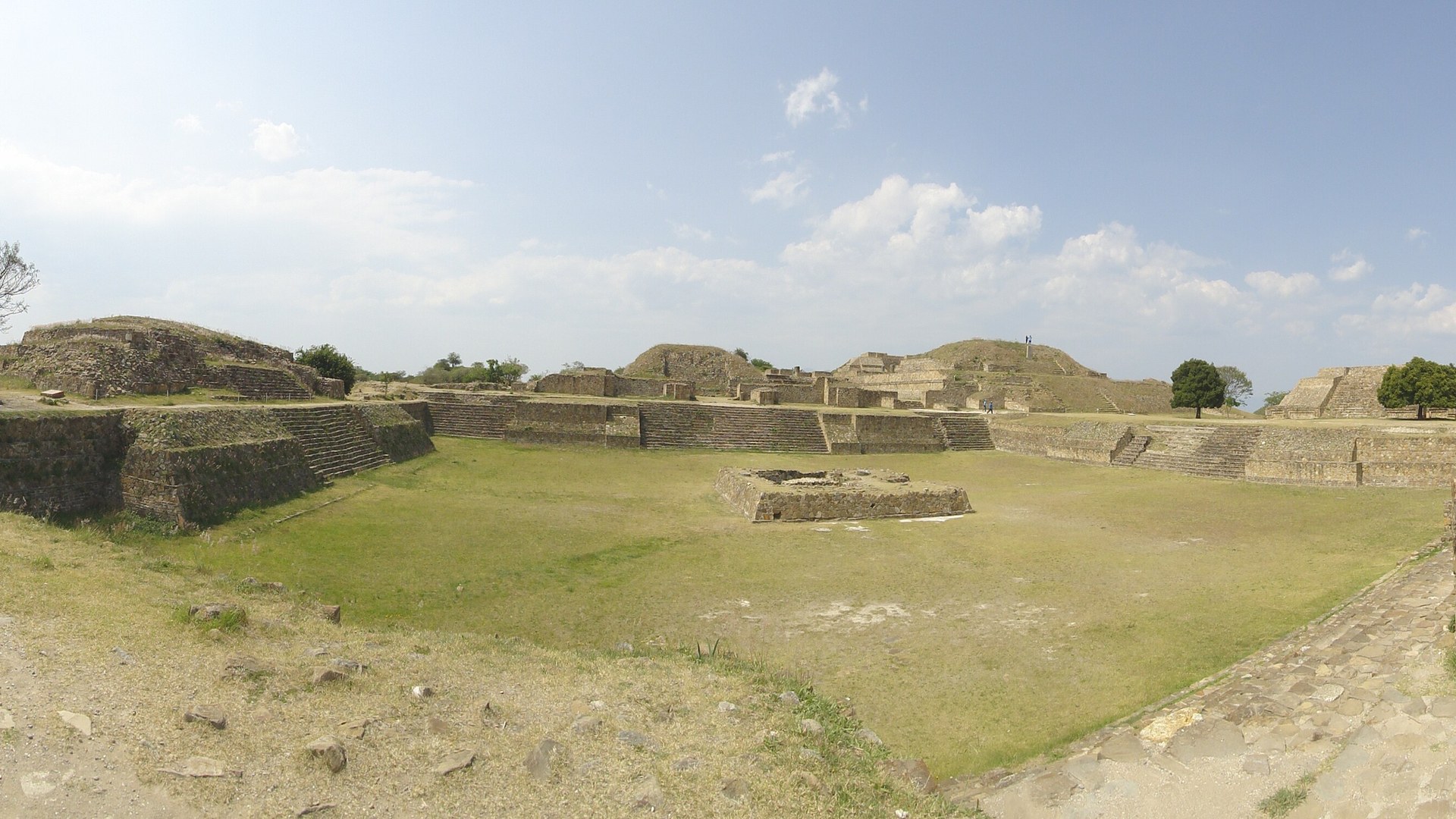
High above Oaxaca’s Central Valleys, Monte Albán preserves one of the most important visual records of the ancient Zapotec world. Its plazas, stepped platforms, carved monuments and glyphs tell the story of a civilization that expressed identity, history and belief through stone.
For Maestro Isaac Vásquez García, these ancient forms became more than archaeological remains. They provided a connection to Zapotec ancestry and a source of inspiration that could be translated into wool.
Through the loom, Isaac transformed elements of this visual heritage into textiles—carrying forms once carved in stone into a living tradition practiced in Teotitlán del Valle.
Monte Albán and the Zapotec World
Monte Albán was established around 500 B.C. and became the political and ceremonial center of the Zapotec civilization. Constructed on a mountaintop overlooking the valleys of Oaxaca, the city included temples, plazas, tombs, ball courts and monumental stone carvings.
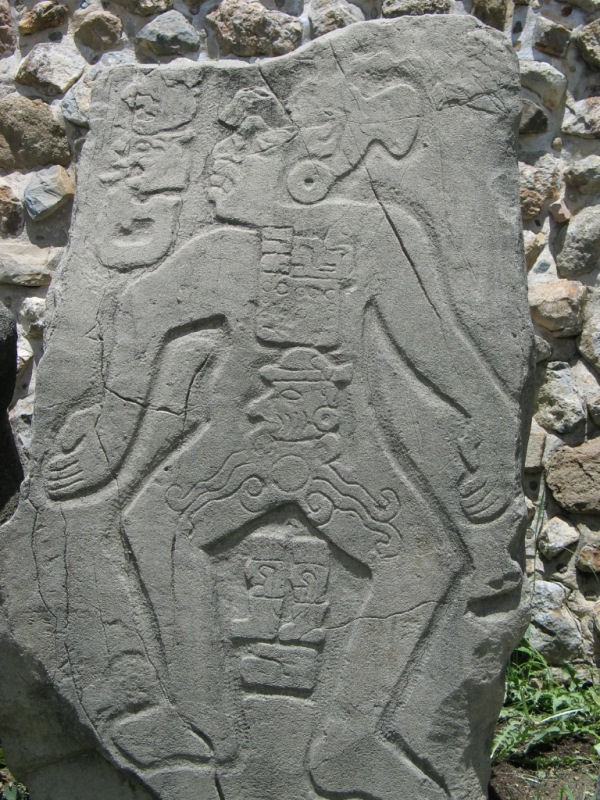
The site is especially important for its stelae—upright stone monuments carved with figures and symbols. The Monte Albán Site Museum preserves examples of some of the earliest known Zapotec writing, including stones covered with glyphs and human figures.
These carvings were not simply decorative. They formed a visual language connected to identity, ancestry, political authority, ceremonial life and the recording of important events.
According to Mexico’s National Institute of Anthropology and History, the museum’s writing collection includes 32 stelae showing the development of Zapotec glyphs from simpler symbols into more elaborate compositions.
Ancient Forms Reimagined in Wool
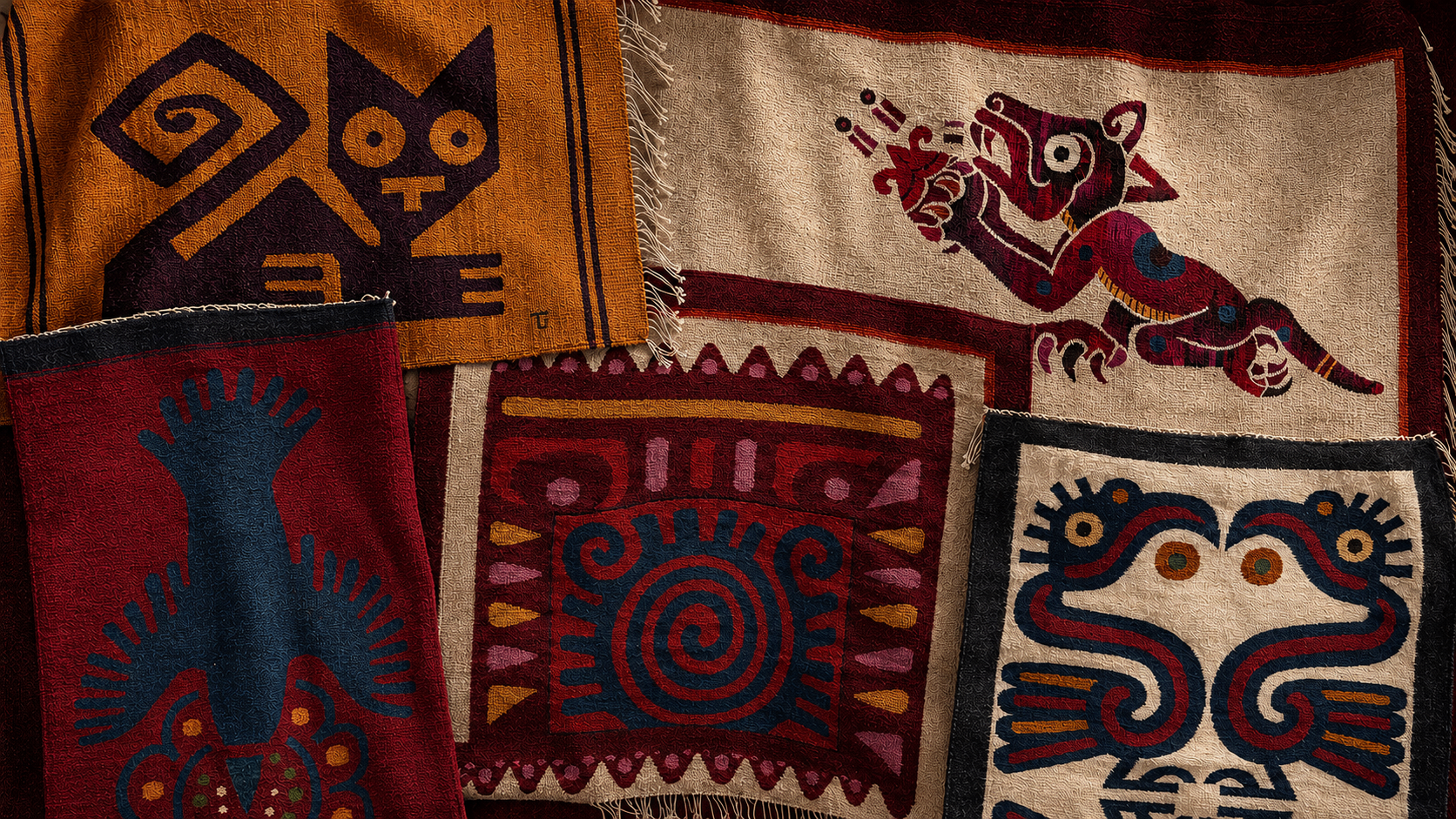
Isaac Vásquez did not reproduce Monte Albán’s monuments as exact archaeological copies. Instead, he interpreted their visual language through the structure of the loom.
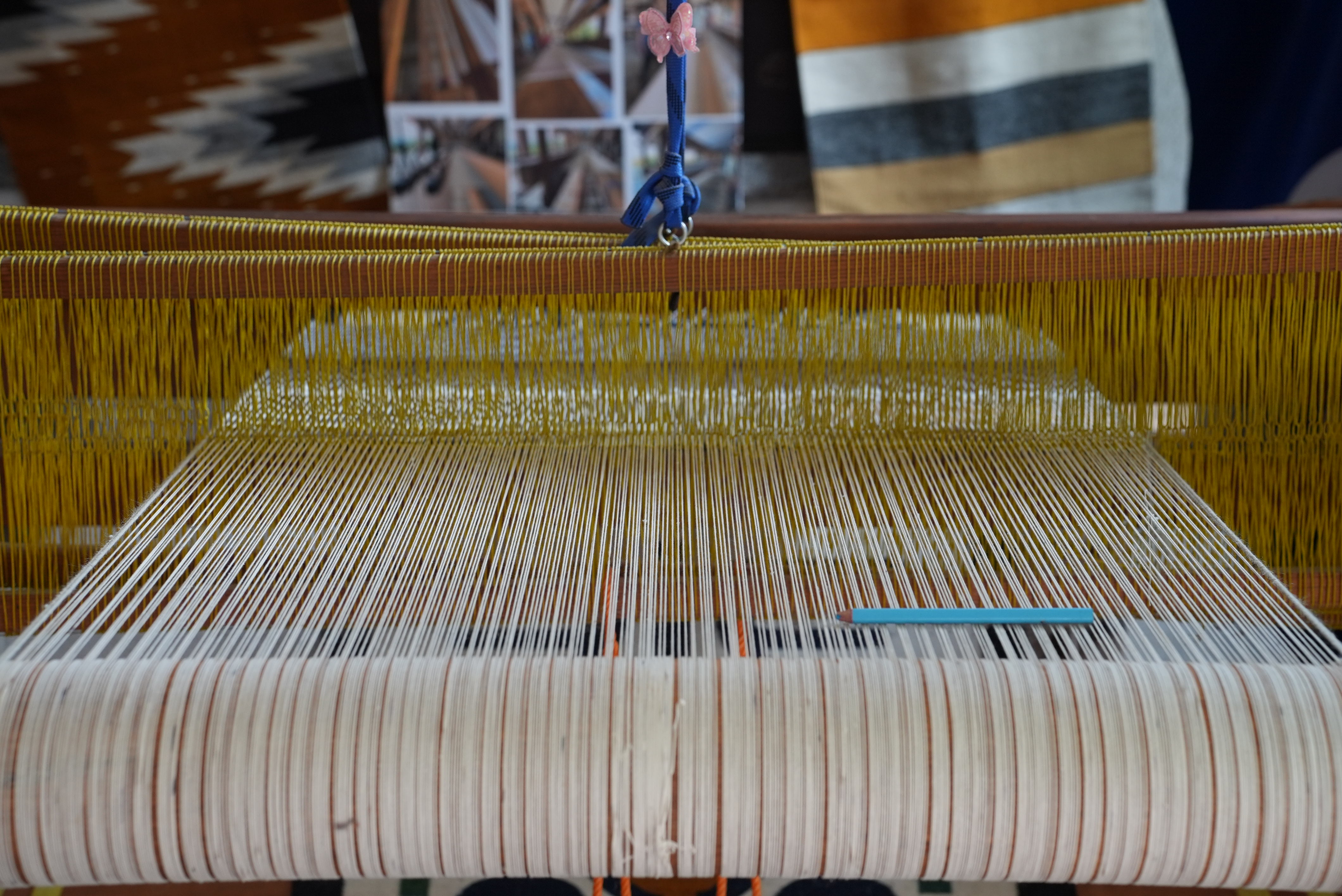
The transition from stone to wool required artistic decisions. Rounded figures became angular. Carved lines became intersections of warp and weft. Monumental forms were reorganized into patterns that could be created by hand on a traditional pedal loom.
This process allowed Isaac to preserve the character of the original imagery while creating something distinctly his own.
Figures inspired by ancient stelae, glyph-like compositions, stepped forms and symbolic animals became part of a body of work that connected the past with contemporary Zapotec weaving.
The Stelae as a Source of Inspiration
Among the clearest connections between Monte Albán and Isaac’s work are the estelas, or stelae.
Monte Albán’s carved stones contain stylized human figures, glyphs and ceremonial imagery. Their strong outlines and geometric organization make them especially suited to interpretation through weaving.
Isaac became recognized for adapting figures from these ancient carvings into textile designs. On the loom, the figure is no longer cut into stone. It emerges slowly through colored wool, one carefully placed line at a time.
The result is not a replica of an artifact. It is a continuation of the artistic conversation that the artifact represents.
The figure is no longer carved into stone. It emerges through colored wool, one carefully placed line at a time.
Jaguars, Eagles and Ancestral Imagery
Animal figures also appear throughout the artistic traditions of ancient Oaxaca. Jaguars, eagles, coyotes, serpents and birds can be found in different archaeological and cultural contexts.
In woven form, these animals may evoke the natural world, strength, transformation or a connection between human and spiritual experience. Their exact meaning, however, should not be generalized. Meaning can change according to the original source, the design and the interpretation of the individual artist.
The Vásquez family’s textiles approach these figures as part of a living visual vocabulary—not as symbols separated from the people and places that created them.
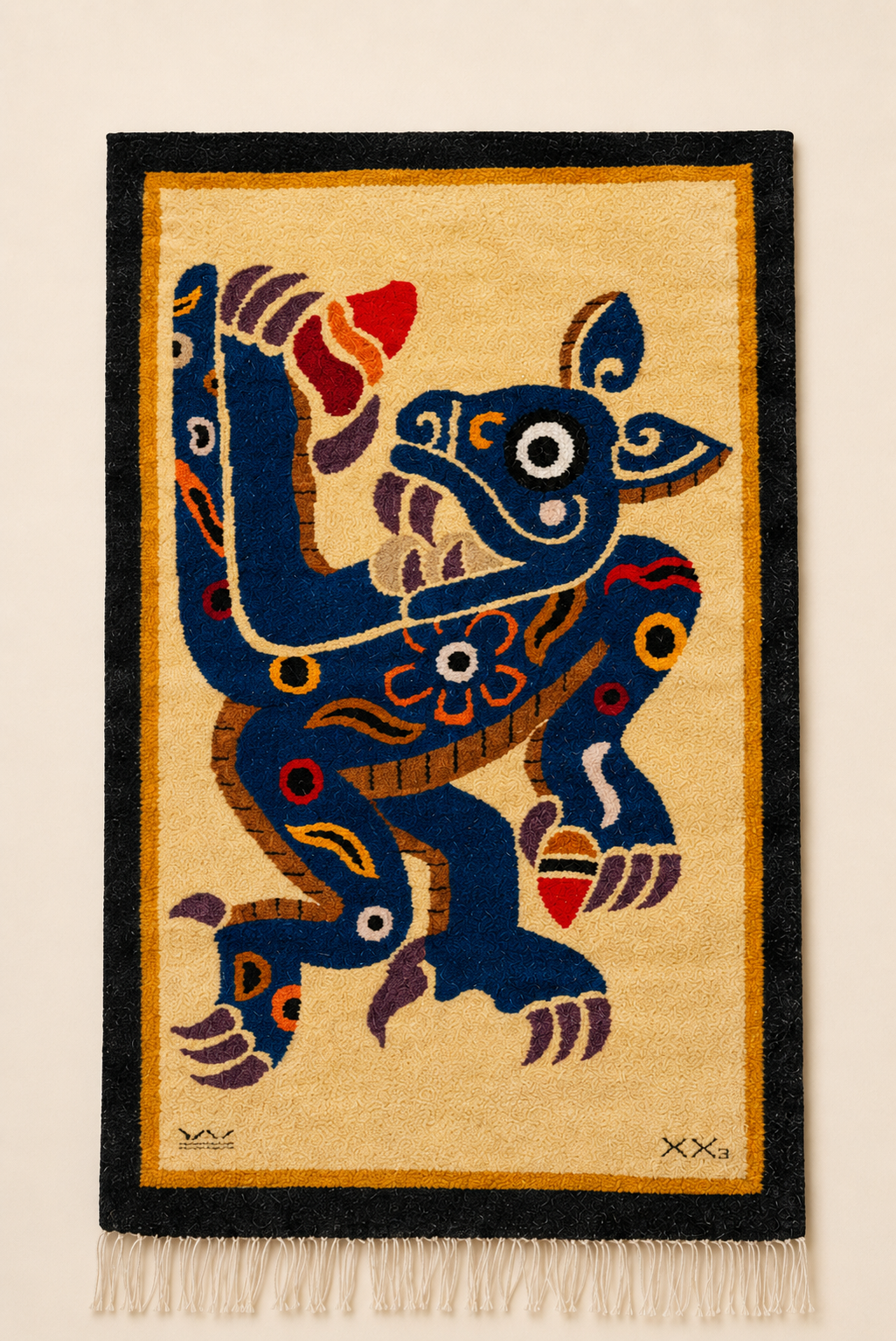
One contemporary example is Jaguar de Monte Albán, a collaborative piece by Wilmer Vásquez Luis and Juan Isaac Vásquez García. Its powerful central figure demonstrates how ancestral imagery continues to be interpreted by new generations of the family.
From the Collection
Jaguar de Monte Albán
By Wilmer Vásquez Luis & Juan Isaac Vásquez García
$1,480
View the PieceThe work does not attempt to make the past static. It shows how an ancient source can continue generating new artistic expression.
Monte Albán and Mitla: An Important Distinction
Monte Albán and Mitla are both essential to Zapotec history, but their artistic characteristics should not be treated as interchangeable.
Monte Albán is especially associated with:
- Carved stelae
- Zapotec glyphs
- Stylized human figures
- Monumental platforms
- Stepped architecture
- Ceremonial and political imagery
Mitla is more directly associated with the intricate stone mosaics known as grecas. These repeating step-fret patterns cover sections of Mitla’s walls and frequently inspire geometric rug designs.
Some Vásquez family textiles draw from Monte Albán, others from Mitla, and still others from nature, historical codices, family memory or contemporary abstraction.
Understanding this distinction gives each design a more accurate and meaningful connection to its source.
Isaac Vásquez and a Living Tradition
Isaac Vásquez García’s importance extends beyond the designs he created. As a master weaver and dyer, he helped renew interest in natural-dye practices at a time when many workshops had moved toward commercially produced colors.
Cochineal could produce deep reds, crimson and rose. Indigo provided shades of blue. Local plants, bark, flowers and other natural materials expanded the family’s palette.
These colors gave Isaac another way to connect ancestral inspiration with the landscape of Oaxaca. The design might draw from an ancient carving, but its color came from materials prepared by hand.
Craft in America describes Isaac as a master weaver and dyer from one of Teotitlán del Valle’s oldest weaving families. His influence continues through the generations that followed him.
Read more about Maestro Isaac Vásquez and his legacy.
Three Generations, One Continuing Story
Today, the Vásquez family continues to work with historical sources while developing its own artistic perspective.
Each generation brings a different relationship to the tradition:
- The grandfather preserved and revived ancestral knowledge.
- The next generation strengthened the family workshop and its techniques.
- The newest generation continues experimenting with composition, scale and color.
This evolution is visible in NISAYA’s Three Generations Collection, where family knowledge is not presented as something frozen in history. It remains active, adaptable and personal.
The loom becomes a meeting place between different periods: ancient Monte Albán, Isaac’s artistic vision and the perspective of the family members weaving today.

More Than a Decorative Pattern
A rug inspired by Monte Albán is not simply a geometric object or a reproduction of an archaeological design.
Its significance comes from the relationships behind it:
- The relationship between Monte Albán and the Zapotec people
- The relationship between stone carving and textile design
- The relationship between Isaac and the generations that followed
- The relationship between natural materials and artistic knowledge
- The relationship between the textile and the home where it will live
When the origin of a design is properly documented, the rug carries more than visual beauty. It carries provenance.
That is why knowing the artisan, workshop and source of inspiration matters when learning how to identify an authentic Zapotec rug.
From Monte Albán to Teotitlán del Valle
Monte Albán is no longer an inhabited Zapotec capital, but its visual language remains present in Oaxaca.
It survives through archaeological preservation, community memory and the work of artists who continue interpreting its forms.
In Isaac Vásquez’s work, the connection between past and present becomes tangible. Stone becomes pattern. Glyph becomes line. Natural color brings ancient imagery into a new material.
The result is not merely an object inspired by history. It is evidence that Zapotec artistic tradition continues to live, change and speak through the hands of its artists.
You can plan a visit to Isaac Vásquez Studio or explore the current NISAYA collection and read about the Teotitlán weaving tradition.